NISM concepts in under a minute
21 short videos with voiceover, each explaining one exam concept with an example and the trap examiners like to set. Turn the sound on, share them with colleagues on WhatsApp, or download them to post yourself.
Chapter 1: Investment Landscape
-
NISM Series V-A · Chapter 1
Goal or objective? The difference examiners test
"I want a comfortable retirement" is an objective. "₹2 crore by age 60, 25 years from now" is a goal, because it has an amount and a date.
-
NISM Series V-A · Chapter 1
Your FD pays 7%. What do you really earn?
An FD pays 7% while inflation is 6%. The real return is 1.07 ÷ 1.06 − 1 = 0.94%, so the money barely grows in real terms.
-
NISM Series V-A · Chapter 1
Why ₹10 lakh today means ₹17.9 lakh tomorrow
A college course costs ₹10 lakh today. At 6% inflation it costs about ₹17.9 lakh in 10 years, so planning for ₹10 lakh leaves a shortfall of almost ₹8 lakh.

Chapter 2: Concept and Role of a Mutual Fund
-
NISM Series V-A · Chapter 2
NAV, AUM and unit capital in one example
A scheme has 5 crore units and an NAV of ₹24. Its AUM is ₹120 crore and its unit capital is ₹50 crore, at the ₹10 face value.
-
NISM Series V-A · Chapter 2
Credit risk fund vs corporate bond fund
Credit risk funds invest in AA and below; corporate bond funds in AA+ and above. And liquid funds go only up to 91 days.

Chapter 3: Legal Structure of Mutual Funds in India
-
NISM Series V-A · Chapter 3
Who actually owns your mutual fund money?
A mutual fund in India is a trust. Investors' money belongs to the trust, not to the sponsor or the AMC, which only manages it.

Chapter 4: Legal and Regulatory Framework
-
NISM Series V-A · Chapter 4
The mutual fund warning you can't rephrase
The standard warning in mutual fund ads must appear word for word. "Past performance may or may not be sustained" is a different disclaimer.

Chapter 5: Scheme Related Information
-
NISM Series V-A · Chapter 5
Which document goes with every application form?
Every mutual fund application form must have the Key Information Memorandum (KIM) attached, not the full SID, the SAI or the factsheet.
-
NISM Series V-A · Chapter 5
Daily, fortnightly or monthly? Fund disclosures
TER is disclosed daily, debt fund portfolios fortnightly and equity fund portfolios monthly. A favourite NISM V-A trap.

Chapter 6: Fund Distribution and Channel Management Practices
-
NISM Series V-A · Chapter 6
Trail commission: the ₹8,000 vs ₹9,600 trap
A client's ₹10 lakh is now worth ₹12 lakh and trail is 0.8% a year. Trail is paid on the current value, so the answer is ₹9,600, not ₹8,000.
-
NISM Series V-A · Chapter 6
The insistent client: what a distributor must do
A 65-year-old client insists on putting all his savings in a small-cap fund. Warn in writing, get his acknowledgement and record the order as "execution only".


Chapter 7: Net Asset Value, Total Expense Ratio and Pricing of Units
-
NISM Series V-A · Chapter 7
IDCW is not extra money. Here's why
NAV is ₹25 and the scheme pays an IDCW of ₹2. NAV falls to about ₹23, so the investor's total wealth is unchanged before tax.
-
NISM Series V-A · Chapter 7
Exit load: what you actually receive
NAV is ₹50 and the exit load is 1%. The investor receives ₹50 × 0.99 = ₹49.50 per unit. Entry loads are not allowed.


Chapter 8: Taxation
-
NISM Series V-A · Chapter 8
Equity fund LTCG tax, worked out
A ₹2,40,000 long-term gain on an equity fund: the first ₹1,25,000 is exempt, so tax is 12.5% of ₹1,15,000 = ₹14,375 plus cess.

Chapter 9: Investor Services
-
NISM Series V-A · Chapter 9
Direct vs regular plan: what's actually different
Direct and regular plans of a scheme hold the same portfolio but have different NAVs, because the regular plan's expense ratio includes distributor commission.
-
NISM Series V-A · Chapter 9
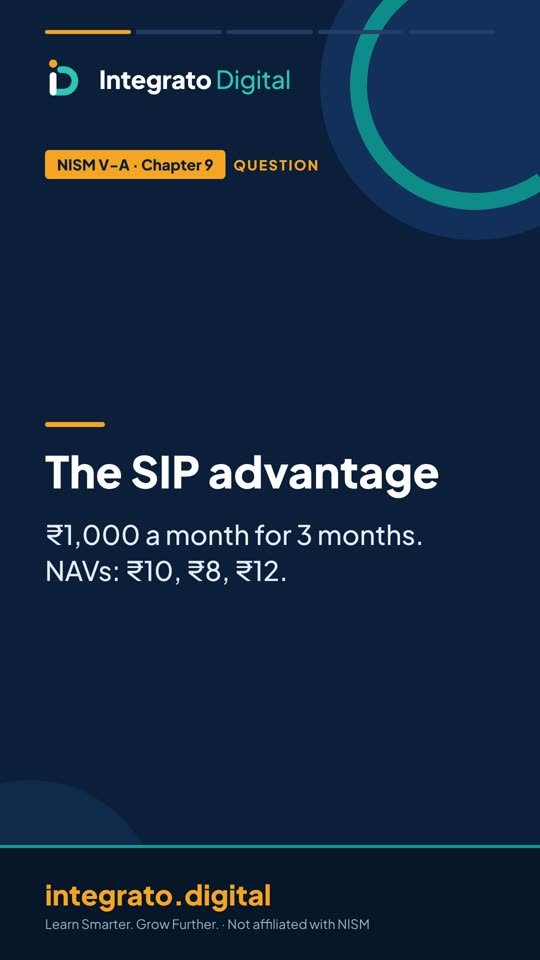
How a SIP lowers your average cost
₹1,000 a month at NAVs of ₹10, ₹8 and ₹12 buys 308.33 units. The average cost is ₹9.73, below the average NAV of ₹10.
-
NISM Series V-A · Chapter 9
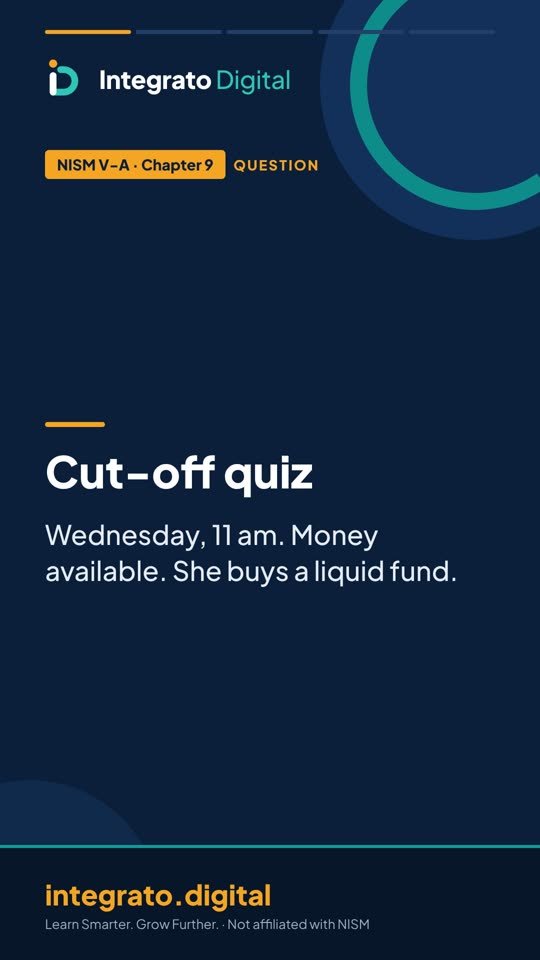
Which NAV for a liquid fund bought on Wednesday?
An investor buys a liquid fund at 11 am on Wednesday, with funds available, before the cut-off. She gets Tuesday's NAV, the day before receipt.
-
NISM Series V-A · Chapter 9
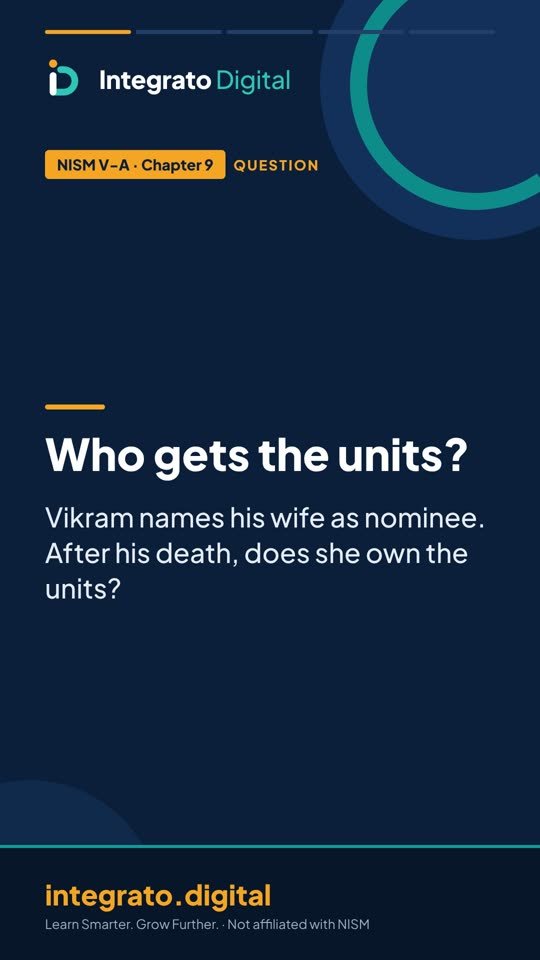
Does the nominee own the units?
After an investor's death the units are transmitted to the nominee, who holds them in trust for the legal heirs. The nominee is not the owner.

Chapter 10: Risk, Return and Performance of Funds
-
NISM Series V-A · Chapter 10
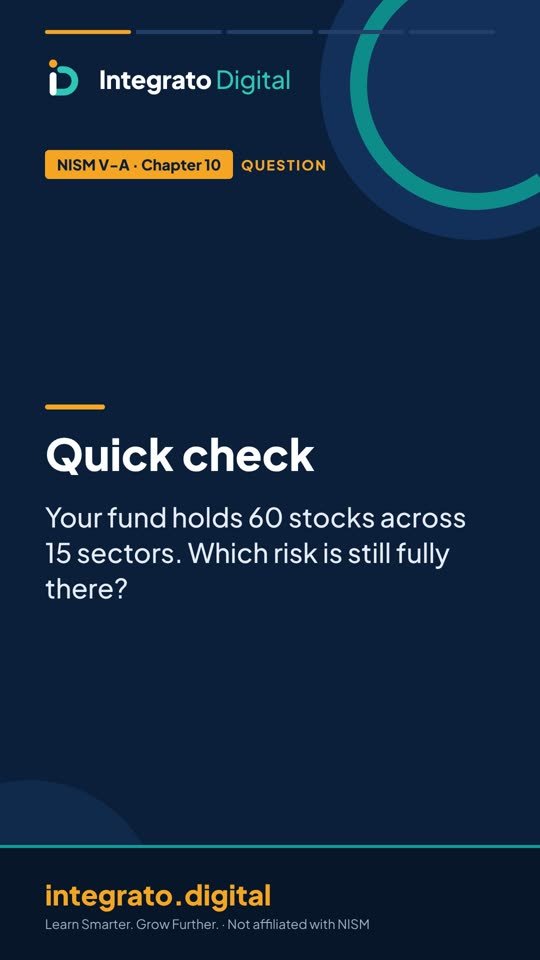
The one risk diversification can't remove
Sixty stocks across fifteen sectors still carry market (systematic) risk. Diversification removes only company-specific risk.
-
NISM Series V-A · Chapter 10
CAGR explained, with the formula
₹1,00,000 grows to ₹1,61,051 in 5 years. The simple return is 61.05%, but the CAGR is 10% a year. Here is the formula and how to use it.

Chapter 11: Mutual Fund Scheme Performance
-
NISM Series V-A · Chapter 11
Why funds are compared with TRI, not PRI
A Total Return Index includes dividends, so it is higher and harder to beat than a Price Return Index. Schemes are benchmarked to TRI since February 2018.

Turn a minute into marks
Each video comes from a full lesson with more examples. Then test yourself with a free full-length mock in the real exam pattern.
You're welcome to share and repost these videos unchanged, with the Integrato Digital branding. Background music is original and made for Integrato Digital. Integrato Digital is independent and not affiliated with NISM.